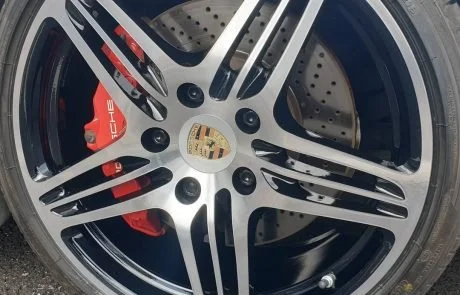
Powder Coating vs SMART Repair for Alloy Wheels
When researching alloy wheel repair, most drivers will quickly encounter two commonly offered solutions: SMART repair and powder coating refurbishment. At first glance, both appear to achieve a similar outcome. They improve the appearance of damaged wheels and restore a cleaner, more presentable finish.
However, beneath that surface similarity lies a fundamental difference in approach.
Understanding the distinction between SMART repair and powder coating is essential, not only for choosing the right service but also for setting realistic expectations around durability, cost and long-term results. While both methods have their place, they are designed to solve very different problems.
What Is SMART Alloy Wheel Repair?
SMART repair, which stands for Small to Medium Area Repair Technology, is a technique developed to address localised damage. Rather than refurbishing the entire wheel, the process focuses only on the affected area, such as a kerb scuff or small scratch.
The repair is blended into the surrounding finish to minimise the visibility of the damage. Because the work is limited in scope, SMART repairs can often be completed relatively quickly and with less material, making them appealing from both a time and cost perspective.
For minor cosmetic issues, this approach can provide an immediate visual improvement. The wheel may appear significantly cleaner and less damaged, particularly when viewed from a distance.
However, the limitations of SMART repair become more apparent over time.
Because only part of the wheel is treated, the remainder of the surface is left unchanged. Any existing wear, fading, lacquer deterioration or corrosion outside the repaired area remains in place. This can lead to inconsistencies in both appearance and performance, particularly as the wheel continues to age.
In addition, achieving a perfect colour match between the repaired section and the original finish can be challenging. Even slight variations in tone or texture may become noticeable under certain lighting conditions.
What Is Powder Coating Alloy Wheel Refurbishment?
Powder coating represents a fundamentally different approach. Rather than targeting a specific area, it involves a full alloy wheel refurbishment process, where the entire wheel is restored.
The process begins by stripping the wheel back to its base material. This removes all existing coatings, contaminants and corrosion, creating a clean foundation for the new finish. Once stripped, the wheel is prepared and any damage is repaired before the coating is applied.
The powder coating itself is applied as a dry material and then cured at high temperature. During curing, the coating bonds to the surface of the wheel, forming a durable, uniform layer.
This method ensures that the entire wheel is treated consistently. There are no transitions between old and new finishes, and no untreated areas where corrosion or deterioration can continue.
Durability: The Key Difference
The most significant difference between SMART repair and powder coating lies in durability.
SMART repairs are, by design, surface-level solutions. They improve the appearance of specific areas but do not address the overall condition of the wheel. As a result, their longevity is influenced by the condition of the surrounding finish. If the original coating begins to degrade, the repaired section may no longer blend seamlessly.
Powder coating, by contrast, is designed for long-term performance. Because the entire wheel is stripped and refinished, the new coating is applied to a stable, uniform surface. The curing process creates a strong bond that is resistant to chipping, corrosion and general wear.
This makes powder coating particularly well suited to alloy wheels, which are exposed to constant environmental stress, including road debris, moisture, brake dust and temperature fluctuations.
Appearance and Consistency
From a visual perspective, the difference between the two methods is also significant.
SMART repair aims to minimise the visibility of damage, but it does not recreate a fully uniform finish across the entire wheel. In some cases, especially on older or more heavily worn wheels, the repaired area may contrast subtly with the rest of the surface.
Powder coating delivers a consistent finish across the entire wheel. Because the previous coating is removed and replaced entirely, the result is uniform in both colour and texture. This is particularly important for drivers looking to restore the overall appearance of their vehicle, rather than simply reduce the visibility of damage.
Cost vs Long-Term Value
Cost is often a deciding factor when choosing between SMART repair and powder coating. SMART repairs are typically less expensive upfront, reflecting the reduced scope of work involved.
However, when considering long-term value, the equation becomes more complex.
A SMART repair may need to be repeated if the surrounding finish deteriorates or if additional damage occurs elsewhere on the wheel. Powder coating, while requiring a higher initial investment, provides a more comprehensive solution that is designed to last.
For drivers planning to keep their vehicle, or those looking to maintain a high standard of appearance, the long-term benefits of full refurbishment often outweigh the initial cost difference.
When Each Method May Be Appropriate
There are situations where SMART repair may be suitable. Minor, isolated cosmetic damage on otherwise well-maintained wheels can sometimes be addressed effectively using this approach, particularly when time constraints are a priority.
However, for wheels showing signs of broader wear, corrosion or multiple areas of damage, a full refurbishment process is generally more appropriate. Treating only part of the problem rarely delivers a consistent or lasting result.
Why Process Matters
One of the key themes in alloy wheel refurbishment is that process matters as much as outcome. Two wheels may look similar immediately after repair, but how they were restored determines how they will perform over time.
At The Wheel Specialist, the emphasis is placed on complete, process-driven refurbishment, rather than isolated cosmetic fixes. By treating the entire wheel and ensuring proper preparation and curing, the aim is to deliver a finish that remains consistent and durable under real-world driving conditions.
The choice between SMART repair and powder coating is not simply about speed or cost. It is about understanding what level of restoration is required and selecting a method that aligns with both the condition of the wheel and the expectations of the driver.