DIY Alloy Wheel Refurbishment vs Professional Repair
The growing availability of DIY alloy wheel repair kits has made wheel refurbishment appear more accessible than ever. A quick online search reveals a wide range of products promising to restore damaged wheels at home, often marketed as a simple and cost-effective alternative to professional services.
For drivers dealing with minor scuffs or cosmetic imperfections, this can be an appealing proposition. The idea of improving the appearance of alloy wheels without the time or cost associated with professional refurbishment is understandably attractive.
However, the reality of alloy wheel refurbishment is far more complex than these kits often suggest. Achieving a durable, consistent and high-quality finish requires a level of preparation, equipment and technical understanding that extends well beyond what is typically possible in a DIY setting.
What DIY Alloy Wheel Repair Kits Offer
Most DIY alloy wheel repair kits are designed to address light cosmetic damage. They typically include materials such as filler, sandpaper, primer and paint, along with basic instructions for application.
In principle, these kits aim to replicate the early stages of professional refurbishment on a smaller scale. The damaged area is cleaned, sanded, filled if necessary, and then repainted to improve its appearance.
For very minor imperfections, this process can produce a visible improvement. Superficial scratches or small kerb marks may become less noticeable, particularly when viewed from a distance.
However, the limitations of this approach become more apparent when considering the broader requirements of proper alloy wheel refurbishment.
The Importance of Surface Preparation
One of the most critical aspects of alloy wheel refurbishment is preparation. Before any coating is applied, the wheel must be thoroughly cleaned, stripped of its existing finish and prepared to ensure proper adhesion.
In a professional environment, this often involves specialist processes designed to remove contaminants, corrosion and previous coatings completely. This creates a stable surface that allows new finishes to bond effectively.
DIY methods typically rely on manual sanding and surface cleaning, which can only address visible areas. Underlying issues such as corrosion beneath the lacquer or contaminants embedded in the surface may remain untreated.
Without proper preparation, even well-applied coatings are unlikely to achieve long-term durability. Peeling, flaking or uneven finishes can develop over time, particularly when the wheel is exposed to real-world driving conditions.
Challenges in Achieving a Consistent Finish
Another significant challenge in DIY alloy wheel refurbishment is achieving a consistent and professional-looking finish.
Alloy wheels are highly visible components, and even minor inconsistencies in colour, texture or application can be noticeable. Matching the original finish requires precise control over materials and application techniques.
Professional refurbishment centres use controlled environments to apply coatings evenly and consistently. Factors such as temperature, humidity and curing conditions are carefully managed to ensure optimal results.
In a DIY setting, these variables are far more difficult to control. Differences in application thickness, drying time or environmental conditions can lead to variations in the final finish.
This is particularly evident when repairing only part of a wheel. Blending a repaired section into the surrounding surface without visible transitions is a complex task, even for experienced technicians.
Durability and Long-Term Performance
While DIY repairs may improve appearance in the short term, durability is often where the difference becomes most apparent.
Alloy wheels are exposed to a range of environmental stresses, including road debris, moisture, brake dust and temperature fluctuations. Any coating applied to the wheel must be able to withstand these conditions without deteriorating.
Professional refurbishment processes, particularly those involving powder coating, are designed with durability in mind. Coatings are applied and cured under controlled conditions to create a strong bond with the wheel surface.
DIY coatings, by contrast, are typically air-dried and lack the same level of adhesion and resilience. Over time, this can lead to chipping, fading or peeling, especially in high-impact areas such as the rim edge.
The Limitations of DIY for More Complex Damage
As the severity of wheel damage increases, the limitations of DIY refurbishment become more pronounced.
Deeper kerb damage, corrosion or issues affecting the structure of the wheel require more advanced repair techniques and equipment. Attempting to address these problems without the appropriate tools can lead to inconsistent results or, in some cases, further damage.
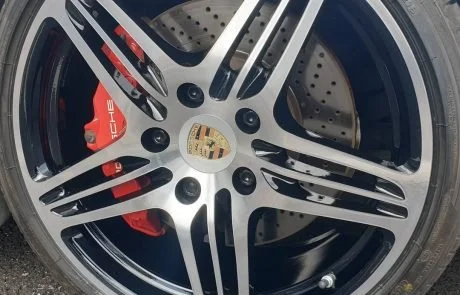
Diamond cut alloy wheels present an additional challenge. These wheels require precision machining to restore their finish, a process that cannot be replicated with DIY methods. Attempting to repair a diamond cut wheel at home will not recreate the original appearance and may compromise the finish further.
Cost vs Outcome: A Practical Perspective
One of the primary motivations behind DIY refurbishment is cost saving. On the surface, repair kits are significantly less expensive than professional services.
However, when considering the outcome, the equation becomes more nuanced. A DIY repair that does not last or fails to achieve a satisfactory finish may need to be repeated or corrected professionally. This can ultimately result in higher overall costs.
Professional refurbishment, while requiring a greater initial investment, is designed to deliver a consistent and durable result. For many drivers, particularly those concerned with maintaining the appearance and value of their vehicle, this represents better long-term value.
When DIY May Be Suitable
There are situations where DIY alloy wheel repair can be appropriate. Minor cosmetic imperfections on older vehicles, where perfect finish is not a priority, may be suitable for this approach.
In these cases, the goal is often to improve appearance rather than achieve a factory-level finish. DIY methods can provide a practical solution when expectations are aligned with the limitations of the process.
Why Professional Refurbishment Delivers Better Results
For drivers seeking a high-quality, long-lasting result, professional refurbishment offers clear advantages. The combination of specialist equipment, controlled processes and technical expertise allows for a level of consistency and durability that is difficult to achieve through DIY methods.
At The Wheel Specialist, refurbishment is approached as a complete process rather than a surface-level repair. Each stage, from preparation to finishing, is carried out with the aim of restoring the wheel to a standard that performs reliably under everyday conditions.
The difference between DIY and professional repair is not simply one of convenience. It is a difference in process, precision and outcome.