What Happens During a Full Alloy Wheel Refurbishment?
For many drivers, alloy wheel refurbishment is understood in simple terms: damaged wheels go in, improved wheels come out. While this is true at a high level, it overlooks the complexity of the process involved.
A full alloy wheel refurbishment is not a single action, but a carefully structured sequence of stages designed to restore both the appearance and durability of the wheel. Each stage plays a specific role, and the quality of the final result depends on how thoroughly each one is carried out.
Understanding what happens during refurbishment helps explain why process matters, why results can vary between providers, and why a proper approach delivers longer-lasting outcomes.
Initial Inspection and Assessment
The refurbishment process begins with a detailed inspection of each wheel. This is where the condition of the wheel is evaluated, including the type of finish, the extent of damage and any underlying issues that may not be immediately visible.
This stage is essential because it determines the appropriate refurbishment method. Painted, powder-coated and diamond cut wheels each require different processes, and identifying the correct approach ensures that the work carried out is suitable for the wheel.
Inspection also helps identify whether there are any structural concerns, such as bends or cracks, that may need to be addressed before cosmetic refurbishment can proceed.
Tyre Removal and Preparation
Tyres are removed from the wheel before refurbishment begins. This allows full access to the entire surface, including areas that would otherwise be difficult to reach.
Removing the tyre also ensures that the refurbishment process is not limited to visible areas only. A complete approach requires access to all parts of the wheel, particularly when applying new coatings.
Preparation at this stage may also include cleaning and degreasing the wheel to remove contaminants such as brake dust, dirt and road residue.
Stripping the Existing Finish
One of the most important stages in alloy wheel refurbishment is the removal of the existing finish. This involves stripping away old paint, lacquer and any corrosion present on the surface.
Stripping is critical because it creates a clean foundation for the new finish. Applying coatings over an existing, compromised surface can lead to poor adhesion and reduced durability.
By returning the wheel to its base material, the refurbishment process ensures that any underlying issues are exposed and can be addressed properly.
Repairing Damage
Once the wheel has been stripped, any damage becomes more visible. This includes kerb marks, scratches, corrosion and surface imperfections.
Repairing this damage is a key stage in achieving a high-quality result. The goal is not only to improve appearance but to create a smooth, uniform surface that is suitable for refinishing.
This stage requires precision. Poorly executed repairs can remain visible even after the new finish is applied, affecting both the look and consistency of the wheel.
Refinishing the Wheel
The refinishing stage varies depending on the type of alloy wheel.
For painted or powder-coated wheels, a new coating is applied across the entire surface. This ensures a uniform finish and restores the original appearance of the wheel.
Powder coating, in particular, involves applying a dry coating that is then cured at high temperature. This creates a strong, durable bond with the surface of the wheel.
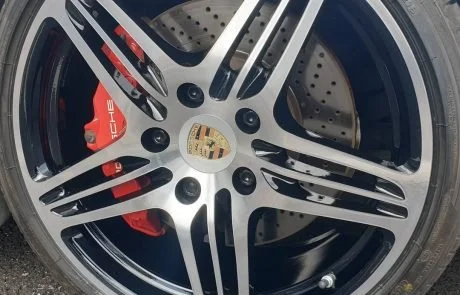
For diamond cut wheels, an additional step is required. After the base coating is applied, the wheel is mounted onto a precision lathe and machined to recreate the distinctive metallic face. This process requires a high level of accuracy to match the original design.
Lacquering and Protection
Once the wheel has been refinished, a protective lacquer is applied. This layer serves as a barrier against moisture, dirt and environmental exposure.
The lacquer is particularly important for maintaining the durability of the finish. It helps prevent corrosion and protects the wheel from the everyday conditions it will face on the road.
For diamond cut wheels, this stage is critical, as the lacquer protects the exposed metal surface created during machining.
Curing the Finish
After application, the coatings must be cured under controlled conditions. Curing allows the finish to bond properly to the surface of the wheel, ensuring both durability and resistance to wear.
This stage is often underestimated, but it plays a vital role in the overall quality of the refurbishment. Insufficient curing can lead to issues such as chipping, peeling or reduced resistance to environmental factors.
Proper curing takes time, and attempting to accelerate this process can compromise the final result.
Final Inspection and Reassembly
Once curing is complete, the wheel undergoes a final inspection. This ensures that the finish is consistent, the repairs are complete and the overall result meets the required standard.
If tyres were removed at the beginning of the process, they are refitted at this stage. The wheel is then ready to be returned to the vehicle.
Why Each Stage Matters
One of the key takeaways from the refurbishment process is that every stage contributes to the final outcome. Skipping or shortening any part of the process can affect both appearance and durability.
For example, inadequate stripping can lead to poor adhesion, while rushed curing can reduce the lifespan of the finish. Similarly, insufficient repair work can leave visible imperfections even after refinishing.
This is why not all alloy wheel refurbishment services deliver the same results. The difference often lies in how thoroughly each stage is carried out.
A Process-Driven Approach to Refurbishment
At The Wheel Specialist, alloy wheel refurbishment is approached as a complete process rather than a series of isolated steps. Each stage is carried out with the aim of achieving a consistent, durable finish that performs reliably under everyday driving conditions.
By focusing on preparation, precision and proper curing, the refurbishment process is designed to deliver results that last, not just results that look good initially.
For drivers, understanding what happens during refurbishment provides clarity on what they are investing in. It is not simply a cosmetic improvement, but a structured process that restores both the appearance and integrity of the wheel.